
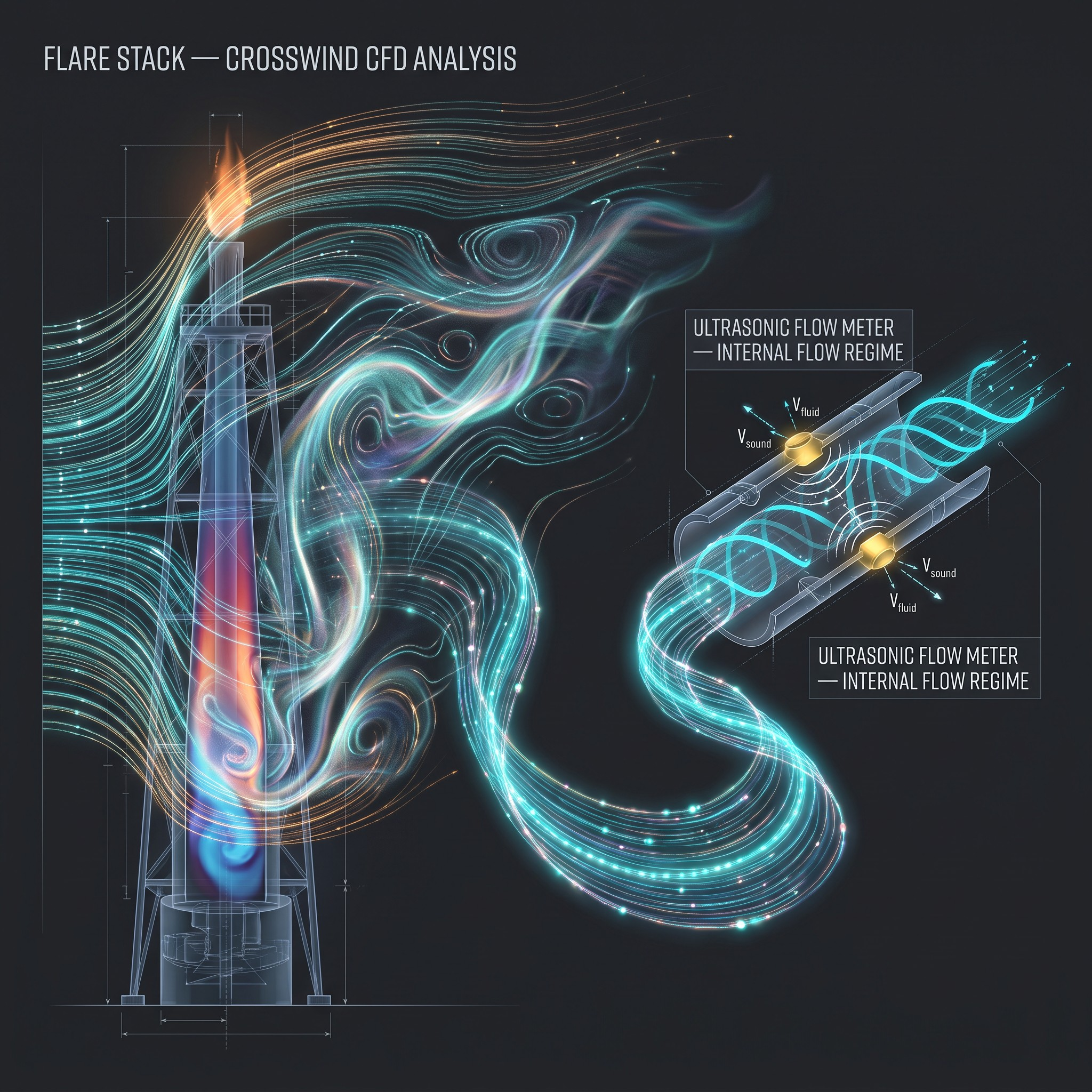
When a flare stack stands more than 100 metres in the air, physical probing is impractical, drone tracking has limits, and regulatory compliance does not wait. Computational Fluid Dynamics (CFD) becomes a critical engineering tool in this situation.
What CFD delivers for flare systems
CFD uses high-performance 3D numerical simulation to replicate real operating conditions. It gives engineers precise, data-driven visibility into systems that are otherwise inaccessible.
Flow and metering accuracy
- Replicates internal fluid behaviour across complex piping headers.
- Quantifies installation errors in ultrasonic flow meters placed in non-ideal geometries.
- Generates site-specific correction factors for auditable flare gas accounting.
Combustion and emissions performance
- Simulates methane combustion efficiency to confirm conversion to CO2 rather than unburnt venting to the atmosphere.
- Models combustion chemistry with detailed reaction kinetics under variable process conditions.
Flame stability and structural integrity
- Assesses flame behaviour and tilt under real crosswind velocity, ambient temperature and humidity.
- Maps thermal deflection envelopes to prevent flame lean-over and tip attachment.
Model inputs we integrate
A high-fidelity simulation requires multidisciplinary data:
- Full 3D piping and metering geometry, including ultrasonic meter placement and upstream and downstream configuration.
- Operating pressures, mass flow rates and gas compositions.
- Site-specific environmental and meteorological data.
- Detailed combustion chemistry and reaction kinetics.
Deliverables
- As-installed metering calibration reports.
- Meter correction factors for regulatory-grade accounting.
- Combustion efficiency analysis across operating scenarios.
- Thermal deflection and flame envelope mapping.
How EnTech can help
Our flare gas CFD modelling and metering support gives operators data-driven answers about their flare systems. Contact us at info@EnTech-Solution.com.