
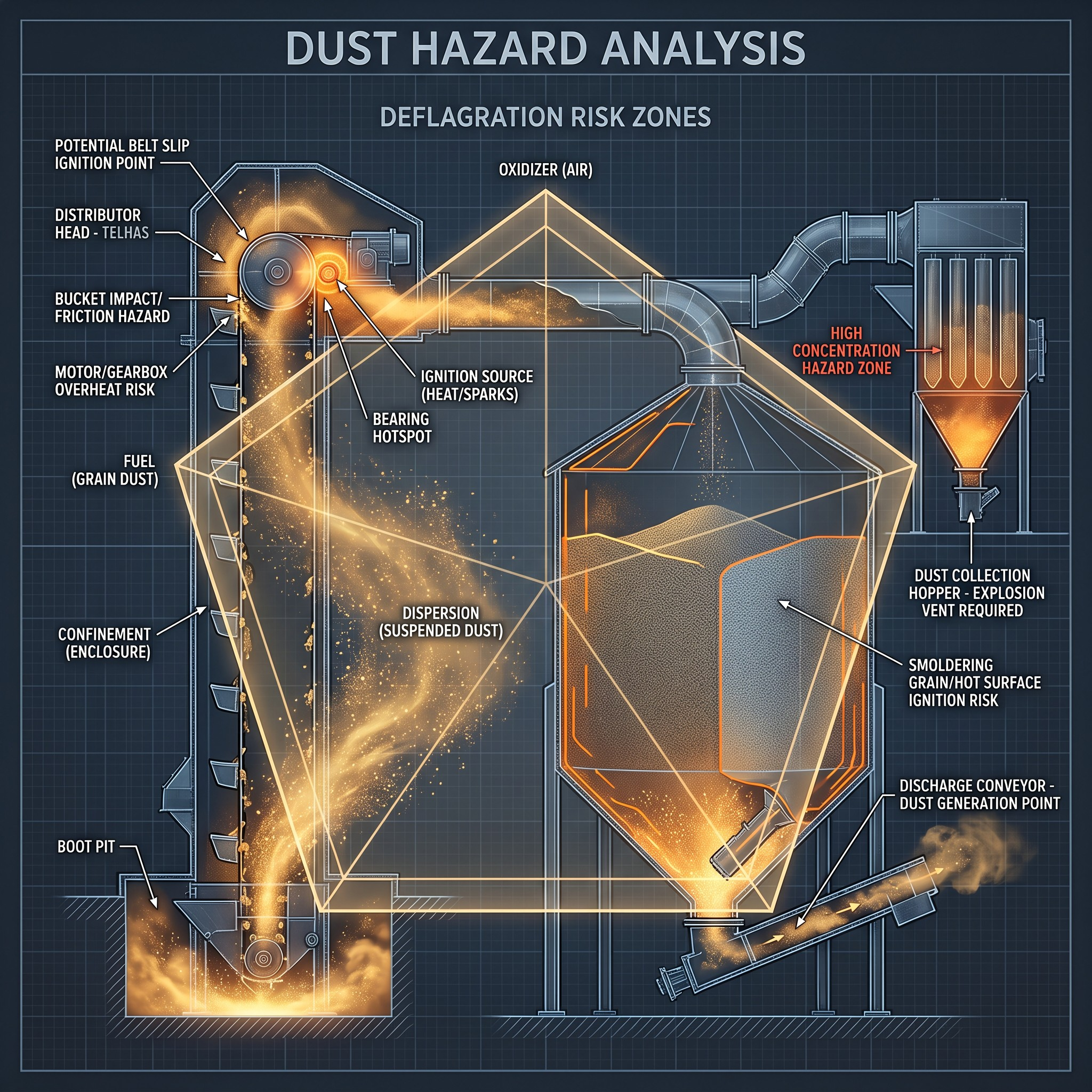
In bulk solid and powder processing industries, and across oil and gas, petrochemical, chemical, power and manufacturing, combustible dust is not just a by-product. It is a critical explosion risk that can escalate rapidly, endanger lives, damage assets and cause major shutdowns. While liquid fires are widely understood, particulate flash fires and secondary dust explosions need a specialised hazard framework.
What is a dust explosion?
A dust explosion is a rapid combustion event that occurs when fine combustible dust particles are dispersed in air and ignited within a confined space. Dust explosions typically develop in two stages:
- Primary explosion within equipment or an enclosed space.
- Secondary explosion, caused when dust layers disturbed by the first event are dispersed and ignited. Secondary explosions are significantly more destructive and are responsible for the most severe consequences.
The dust explosion pentagon
For a dust explosion to occur, five elements must be present together:
- Fuel. Combustible dust.
- Oxygen. Air.
- Ignition. Sufficient ignition energy.
- Confinement. An enclosed or semi-enclosed space.
- Dispersion. Formation of a dust cloud.
Where is the risk?
- Silos and storage systems.
- Conveying systems such as bucket elevators.
- Dust collectors and filtration systems.
- Mills and processing equipment.
- Handling and production areas.
Understanding explosibility: dust testing
Knowing the properties of a dust is essential for safe design and operation. Laboratory testing measures:
- KSt (deflagration index) and Pmax (maximum explosion pressure), which describe explosion severity.
- MIE (Minimum Ignition Energy) and MIT (Minimum Ignition Temperature).
- MEC / LEL (Minimum Explosible Concentration / Lower Explosion Limit).
- LOC (Limiting Oxygen Concentration).
These values establish safe operating envelopes and support compliant Hazardous Area Classification for dust zones.
Core pillars of the Dust Hazard Analysis lifecycle
- Combustible dust characterisation. Identify particulate materials across process units, dust collectors and conveying systems, supported by laboratory testing.
- DHA execution. Systematically evaluate equipment, transfer points and elevated surfaces for primary and secondary dust cloud formation.
- Ignition source identification and HAC zoning. Map electrostatic discharge, mechanical sparks, hot surfaces and electrical apparatus categories to define combustible dust zones.
- Explosion prevention and protection engineering. Implement explosion venting, chemical suppression, isolation barriers, inerting and robust housekeeping aligned with NFPA standards, including NFPA 652 and NFPA 660.
Key risk reduction measures
- Effective housekeeping to prevent dust accumulation.
- Proper ventilation and dust control systems.
- Identification and control of ignition sources.
- Explosion protection and mitigation systems.
- Testing of dust explosibility characteristics.
Why it matters
A thorough Dust Hazard Analysis quantifies particulate risk, isolates explosion propagation pathways and keeps facility designs compliant with international safety standards. It prevents catastrophic explosions, protects personnel and assets and supports regulatory compliance.
How EnTech can help
We provide dust hazard identification and assessment, explosion risk analysis and testing, mitigation and protection strategies, integration with process safety studies and auditable engineering documentation. Contact us at info@EnTech-Solution.com.