
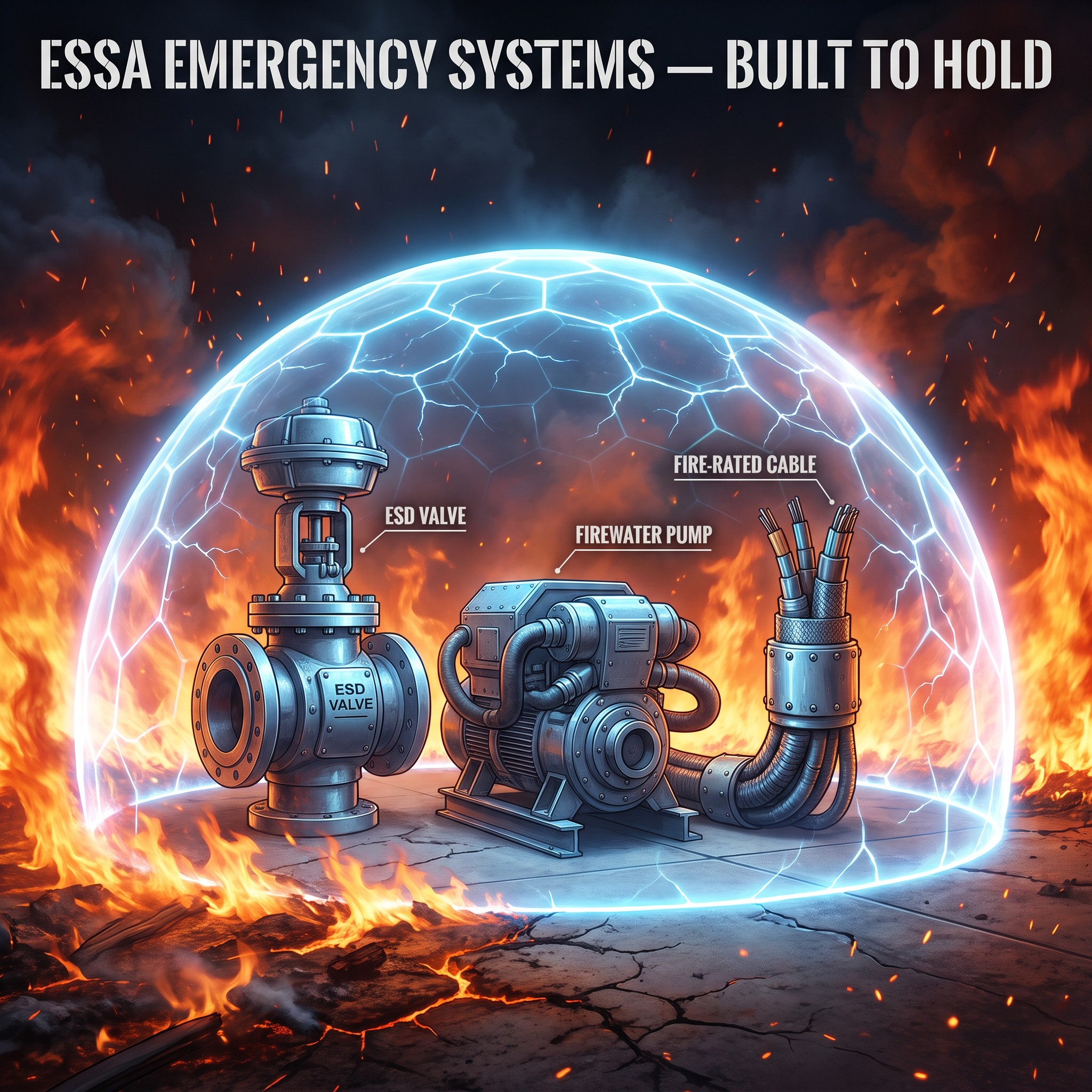
In high-hazard process facilities, simply installing Safety Critical Elements (SCEs) is not enough. The real engineering question is whether your active defences will survive and stay fully operational during a real major accident. An Emergency Systems Survivability Assessment (ESSA), guided by standards such as ADNOC ST-08, API 14J / 14C and API 2018, evaluates whether emergency systems can withstand extreme thermal radiation, blast overpressure and environmental loads without losing function.
What is ESSA?
ESSA is a structured assessment of whether critical emergency systems can continue to operate as intended during credible Major Accident Events (MAEs). It focuses on their ability to mitigate accident consequences, prevent escalation, and support escape, temporary refuge, evacuation and recovery.
Why ESSA is important
- It identifies the emergency systems that are critical to personnel life safety.
- It assesses their vulnerability during worst-case MAEs.
- It evaluates robustness, redundancy and fail-safe features.
- It verifies that systems can perform for the whole required endurance time.
- It reduces escalation risk and improves emergency response reliability.
Which Major Accident Events are considered?
- Hydrocarbon MAEs. Fires, explosions, smoke, thermal radiation and overpressure.
- Non-hydrocarbon MAEs. Extreme weather, dropped objects, ship collision and helicopter incidents.
Both local and global effects on emergency systems are assessed.
Core pillars of ESSA
- Prerequisite safety integration. ESSA relies on inputs from HAZID, Bowtie Analysis and FERA to map Major Accident Hazards down to specific tag-level safety elements.
- Vulnerability and thermal limits. Structural members, ESD valves and PFP are evaluated against severe jet and pool fires (resisting heat flux up to 37.5 kW/m²) and blast overpressure, so that failure modes are fail-safe.
- Fail-safe and redundancy verification. Fire and Gas voting logic, emergency escape lighting and PA/GA communication systems are checked for enough physical separation and redundancy to keep working through toxic releases or localised fires.
- Power and cable survivability. UPS backup loops and fire-rated cabling (IEC 60331 / 60332) must survive the critical initial emergency window, so that automated depressurisation through blowdown valves and flare ignition can proceed.
How an ESSA is carried out
A step-based approach is used: identify and review MAEs, identify the critical emergency systems, assess redundancy and fail-safe features, assess vulnerability against each MAE, then rank risks qualitatively and identify improvement actions. The quality of the result depends heavily on experienced facilitation and realistic scenario evaluation.
Localised damage must never compromise facility-wide safety. ESSA ensures that even under severe accident conditions, containment, depressurisation and life-safety systems survive to protect lives and prevent catastrophic collapse.
How EnTech can help
We provide emergency systems survivability assessments, multidisciplinary facilitation and practical recommendations to prevent escalation and protect personnel. Contact us at info@EnTech-Solution.com.