
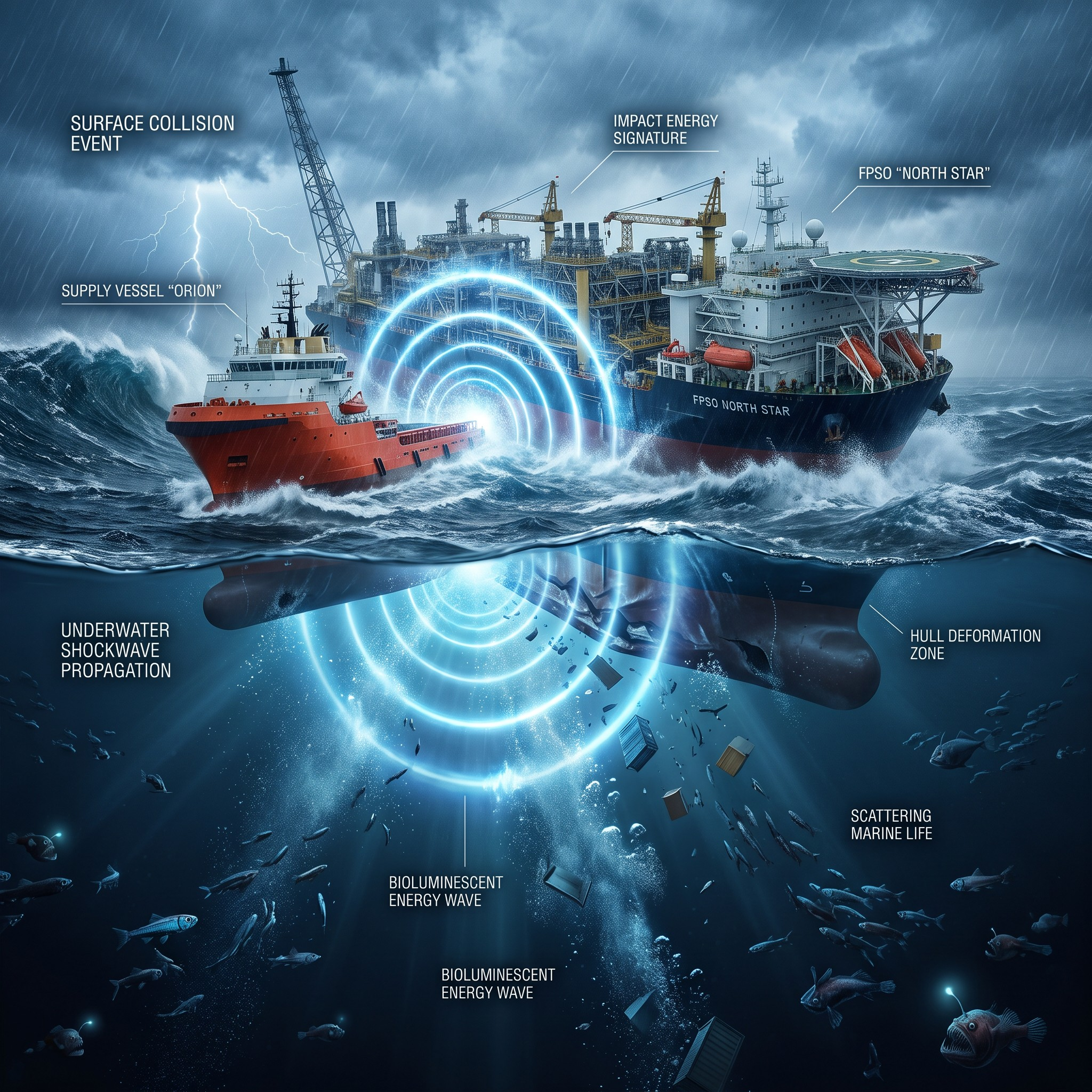
Ship collisions with offshore installations such as FPSOs and wellhead platforms are a critical hazard that can lead to major accidents, loss of containment and environmental impact. Offshore structures that operate near marine traffic must be able to keep their load-carrying capacity and energy absorption during an accidental vessel collision. A structured ship collision study identifies, assesses and mitigates these risks.
What is a ship collision / ship impact study?
It is a systematic assessment of collision risk between ships and offshore installations (FPSOs and fixed platforms). It identifies scenarios, causes, frequencies and consequences using qualitative and quantitative methods, assesses ship-to-platform collision frequencies, and defines the structural requirements needed to withstand vessel impacts. It translates maritime traffic data into practical engineering design criteria.
Why it is important
- It protects offshore personnel and critical assets.
- It reduces loss of containment and hydrocarbon release.
- It minimises environmental pollution.
- It addresses human, technical and organisational factors.
- It supports regulatory compliance and offshore risk management.
The two main collision scenarios
- Powered collision (errant vessel). A vessel is fully under power but off course, typically because of a watch-keeper failure, radar misinterpretation or navigational error.
- Drifting collision (passing vessel). A vessel on a designated route loses propulsion or steering and drifts toward an offshore structure under wind, waves and currents.
Studies cover both ship collision with an FPSO and ship collision with a fixed offshore wellhead platform.
Methodology
- Marine traffic and historical data analysis.
- Collision frequency and probability estimation, using normally distributed geometric collision probabilities to map vessel paths against platform dimensions.
- Impact energy calculation, based on vessel displacement, velocity and hydrodynamic added mass.
- Assessment of causes, consequences and environmental impact, including a Quantitative Risk Assessment (QRA).
- Collision simulations covering impact location, angle and speed.
- Workshop-based review and recommendations.
Common factors in ship collision
Vessel speed and displacement, environmental conditions, structural design and collision resistance, lack of installation awareness, human error, and navigation or radar equipment failure.
Key study outputs
- Platform-specific collision frequency per year.
- Kinetic impact energy profiles for structural design and jacket validation, plotting collision frequency against impact energy (kJ / MJ).
- Mapping of passing and merchant vessel traffic density.
- Evaluation of existing risk-reduction barriers such as radar monitoring, standby vessels and exclusion zones.
Structural integrity under ship impact loads
Structural assessment ensures that topsides and jacket structures keep their load-carrying capacity and energy absorption during extreme impact. The key engineering aspects are:
- Impact energy and kinematics. Vessel mass, speed and angle set the collision energy, which must be dissipated by plastic deformation of the hull and jacket.
- Pre-impact stress state. Collision loads are evaluated together with operational gravity loads, so members do not exceed strain limits before impact.
- Plasticity and progressive collapse. Nonlinear analysis identifies yielding and plastic hinges. Collapse before the energy has been absorbed calls for structural redesign.
- Design criteria (NORSOK / API). Ductile design concepts manage plastic deformation without joint punching or frame collapse.
- Nonlinear FEA simulation. Advanced modelling captures strain hardening, local denting and global bending to verify post-collision reserve strength (RSR).
Local member damage and plastic deformation are acceptable, provided the platform as a whole keeps enough residual strength to prevent major loss or collapse.
How EnTech can help
We offer DNV RP-107 collision risk modelling, dynamic impact energy and structural consequence evaluations, maritime traffic data integration and risk profiling, and technical safety and barrier optimisation reports. Contact us at info@EnTech-Solution.com.