
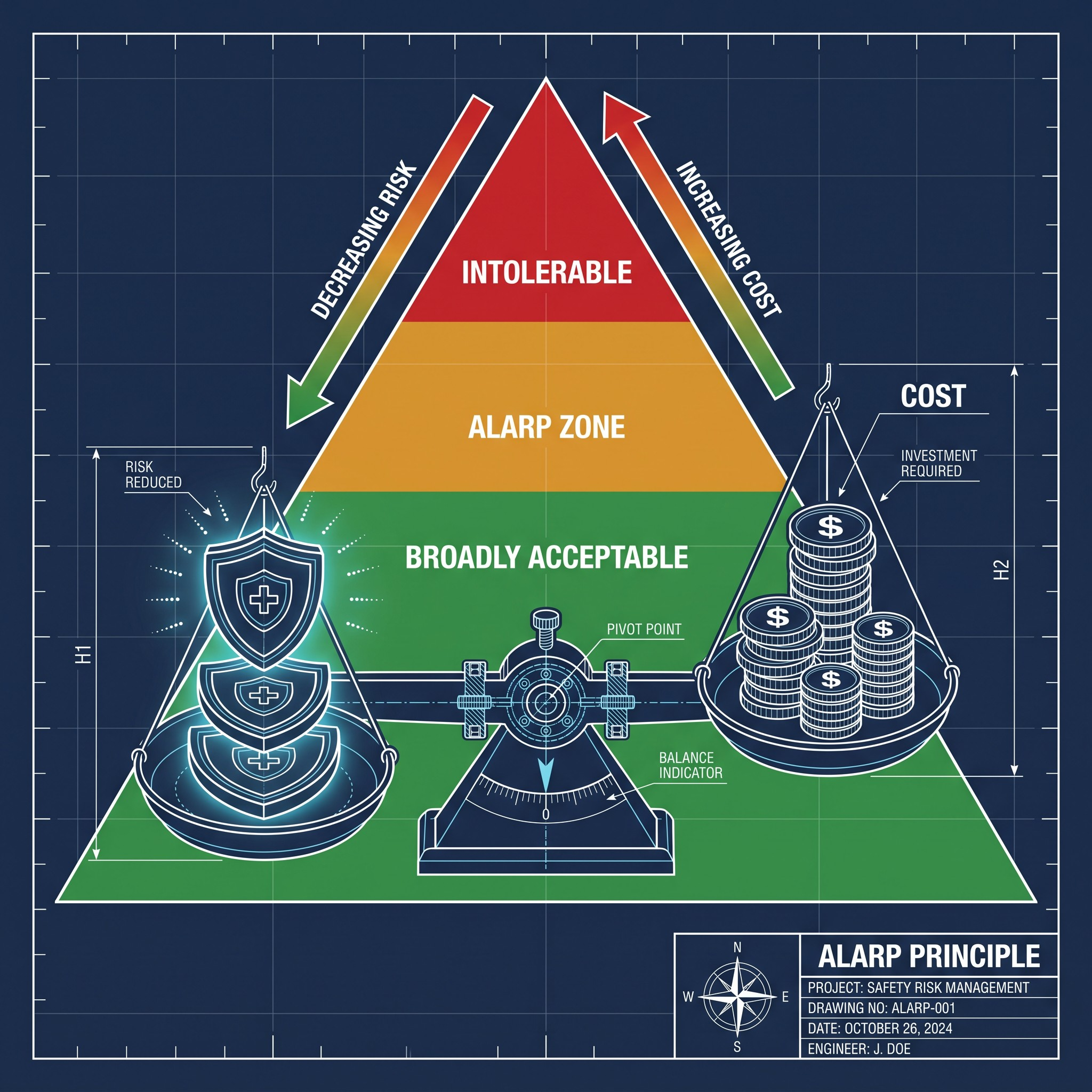
In major hazard industries, safety is not about eliminating all risk, because no industrial operation is entirely risk-free. The real objective is to show that risk has been reduced to a level that is As Low As Reasonably Practicable (ALARP). The central challenge is judging whether a safeguard is truly proportionate to the risk, or whether adding it would be engineered over-design.
What is ALARP?
ALARP is both an engineering and a legal principle. It requires risk to be reduced to a defensible level, where any further reduction would need cost, time or effort that is grossly disproportionate to the safety benefit gained. It supports balanced decisions by weighing safety improvement, technical feasibility and cost-benefit justification.
The three regions of risk
After risk assessment and the implementation of safeguards, residual risk falls into one of three regions:
- Unacceptable region. Risk is intolerable. Mitigation is mandatory regardless of cost.
- Tolerable (ALARP) region. Risk is tolerated only if further reduction is shown to be grossly disproportionate to its cost.
- Broadly acceptable region. Risk is negligible. The current level of safety is considered adequate.
The principle of proportionality
ALARP is about making rational, data-driven safety investments. Proportionate safeguards are practical controls that effectively address credible risks. Disproportionate safeguards are measures whose cost and effort greatly exceed the risk reduction they deliver, and these do not have to be implemented.
How to demonstrate ALARP compliance
To prove ALARP to regulators and independent auditors, engineering teams need a structured and documented evaluation:
- Follow recognised good practice. Align design and operation with established standards and regulations (such as API, ISO and OSHA) as the mandatory baseline.
- Apply cost-benefit analysis (CBA). Evaluate additional barriers and reject them only where the cost is grossly disproportionate to the risk reduction.
- Document rejected safeguards. Record every additional barrier that was considered but not implemented. This is the auditable proof that the decision was reasoned.
When should ALARP be demonstrated?
- During major hazard assessments such as HAZOP and QRA.
- During design safety reviews and project development stages.
- As part of safety case submissions.
- During operational risk evaluations and modifications (Management of Change).
- For risk-based project approvals in high-hazard environments.
A multidisciplinary team is essential to keep the outcome objective and robust.
The essential question
The question every ALARP study keeps asking is: What more could we do to reduce risk, and can we justify why we are not doing it? Achieving ALARP is not a one-time milestone. It requires continuous vigilance and a willingness to challenge designs for further opportunities to reduce risk.
How EnTech can help
Our ALARP support includes review of major risk contributors and existing safeguards, validation of QRA and supporting studies, assessment of additional risk reduction measures, proportionate cost-benefit analysis and clear, auditable documentation. Contact us at info@EnTech-Solution.com.