
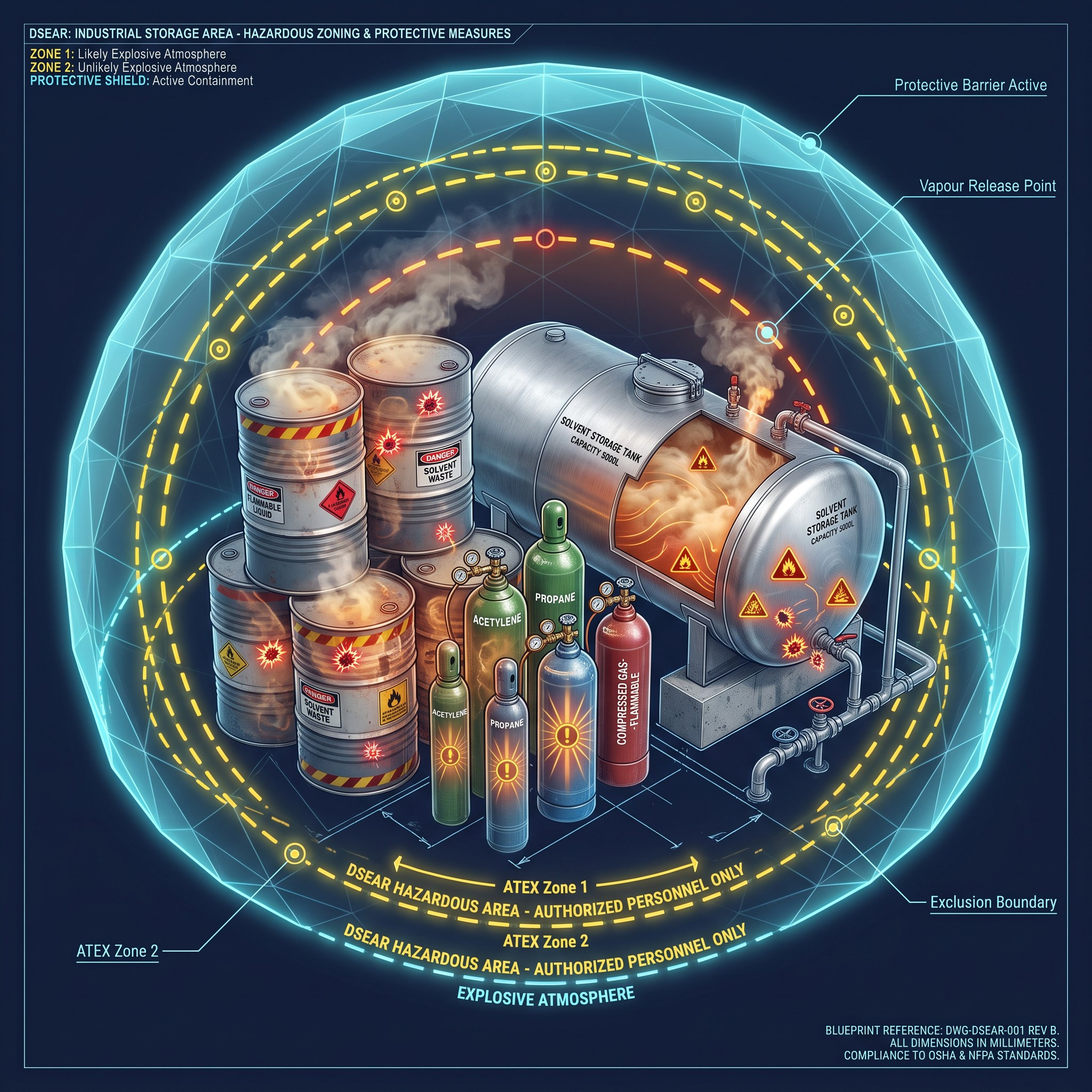
Ignoring explosive and corrosive risks can expose a facility to serious operational and legal consequences. In environments handling flammable gases, volatile liquids or combustible dusts, safety depends on strict compliance, and this is where the Dangerous Substances and Explosive Atmospheres Regulations (DSEAR) become essential.
What is DSEAR?
DSEAR (the Dangerous Substances and Explosive Atmospheres Regulations 2002) is a UK regulatory framework that requires employers to protect workers, the public, assets and facilities from fire, explosion and corrosive-substance hazards linked to the use, handling and storage of dangerous substances. It applies to most industrial and commercial workplaces where flammable gases, vapours, dusts or liquids may be present.
What counts as a dangerous substance?
Dangerous substances are present in almost every industrial workplace. They include:
- Flammable gases and liquids. LPG, methane, solvents, paints and varnishes.
- Combustible dusts. Fine powders from machining, sanding, or chemical and foodstuff processing.
- Chemical threats. Pressurised gases and highly concentrated substances that corrode metal.
Six steps to DSEAR compliance
- 1. Risk identification. Audit and identify every dangerous substance in the workplace.
- 2. Mitigation controls. Eliminate the risk at source, or control it strictly.
- 3. Consequence reduction. Put physical safeguards in place to reduce the impact of any fire or explosion.
- 4. Hazardous area classification. Identify, map and classify the zones where explosive atmospheres can occur (ATEX / DSEAR zoning).
- 5. Ignition source control. Eliminate ignition sources, such as unprotected or non-Ex-rated equipment, inside classified zones.
- 6. Emergency preparedness. Establish mitigation plans, procedures and specialist training to handle accidents or breaches.
DSEAR assessment methodology
A DSEAR assessment identifies dangerous substances and potential explosive atmospheres, classifies hazardous areas, evaluates ignition sources and existing safeguards, assesses the likelihood and consequences of fire and explosion scenarios, defines engineering, procedural and organisational controls, and reviews emergency response and preparedness.
DSEAR outputs
- A risk register for dangerous substances and explosive atmospheres.
- Hazardous area classification (zone drawings).
- Defined prevention and mitigation measures.
- An action plan to achieve regulatory compliance.
- A clear, auditable DSEAR assessment report.
Why it matters
DSEAR compliance is active risk protection. It demonstrates compliance with UK fire and explosion safety regulations, reduces the likelihood of major accidents, protects people, assets and business continuity, and supports safe plant design and operation.
How EnTech can help
We provide comprehensive DSEAR risk assessments and site audits, Hazardous Area Classification and Ex-zone mapping, ignition source risk analysis and equipment verification, and emergency response and process safety mitigation planning. Contact us at info@EnTech-Solution.com.