
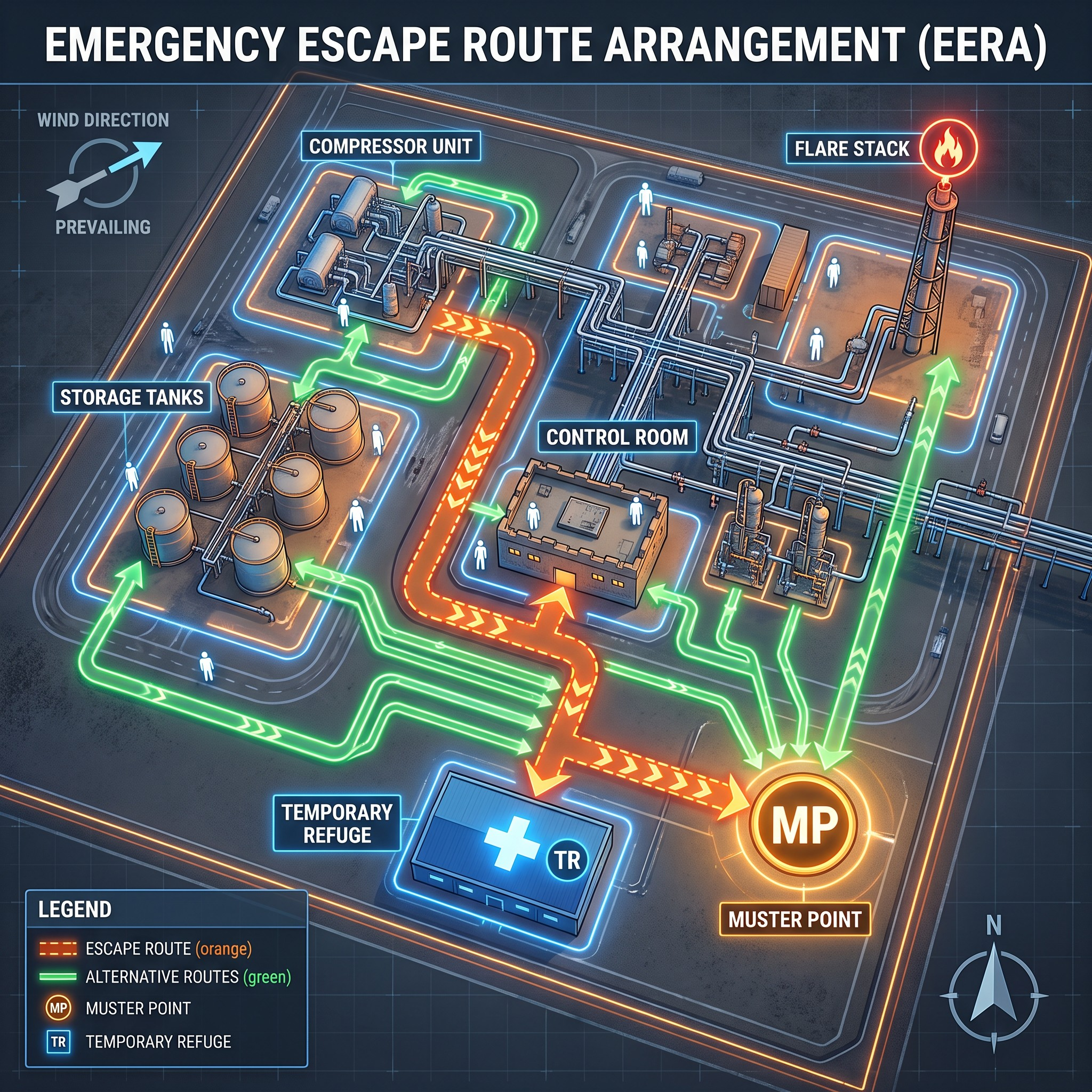
In process industries, ensuring personnel life safety during an emergency is a fundamental requirement for safe project execution. In high-hazard facilities, people must be able to navigate, muster and evacuate safely during a Major Accident Hazard (MAH) event. Escape, Evacuation and Rescue Analysis (EERA) provides a structured, engineering-based framework, within COMAH and Safety Case regimes, to evaluate emergency preparedness, life-safety systems and temporary refuge integrity.
What is EERA?
EERA is a structured assessment technique that evaluates the adequacy of escape routes, evacuation arrangements and rescue provisions for personnel in credible emergency scenarios. It is most effective when carried out early in design, using a qualitative approach, and it examines how thermal radiation, toxic ingress and blast affect primary and secondary escape routes, so that arrangements remain robust under worst-case conditions.
Why EERA is important
- It identifies constraints and weaknesses in escape and evacuation routes early in the project lifecycle.
- It verifies that the layout supports safe and timely evacuation.
- It compares evacuation time with the Available Safe Egress Time (ASET).
- It evaluates rescue accessibility and emergency response effectiveness.
- It reduces the cost of late design changes by addressing life-safety risk early.
Core pillars of the EERA lifecycle
- MAH and emergency scenario identification. Loss-of-containment scenarios, smoke dispersion, toxic gas releases and jet fires are evaluated to establish credible threats to the escape network.
- Goal-based assessment criteria. The emergency lifecycle is analysed stage by stage: alarm, detection, escape, mustering, Temporary Refuge (TR), evacuation and rescue.
- Temporary Refuge integrity evaluation. TR impairment factors are assessed, including structural endurance, smoke leakage, toxic gas ingress and life-support duration.
- Emergency response and strategy optimisation. Recommendations cover layout modifications, protected egress, backup muster points and alignment with regulatory and international HSE standards.
When should EERA be conducted?
- During early project design and layout development.
- Before major design and safety system freeze milestones.
- As part of Management of Change (MoC) for modifications or expansions.
- Throughout the project phases, from early design through operation to decommissioning.
How an EERA is conducted
A successful EERA needs a multidisciplinary team (process, HSE, operations and emergency response), an experienced facilitator, a scribe to document scenarios, evacuation assumptions, findings and actions, and active team participation so that realistic emergency conditions are considered. The effectiveness of the study depends heavily on the experience and practical knowledge of the team.
A comprehensive EERA confirms that escape routes are verified, life-safety systems are resilient and personnel protection is prioritised in every operational phase.
How EnTech can help
We provide life-safety and emergency preparedness assessments, Safety Case development, experienced multidisciplinary facilitation, and practical recommendations to improve escape, evacuation and rescue capability. Contact us at info@EnTech-Solution.com.