
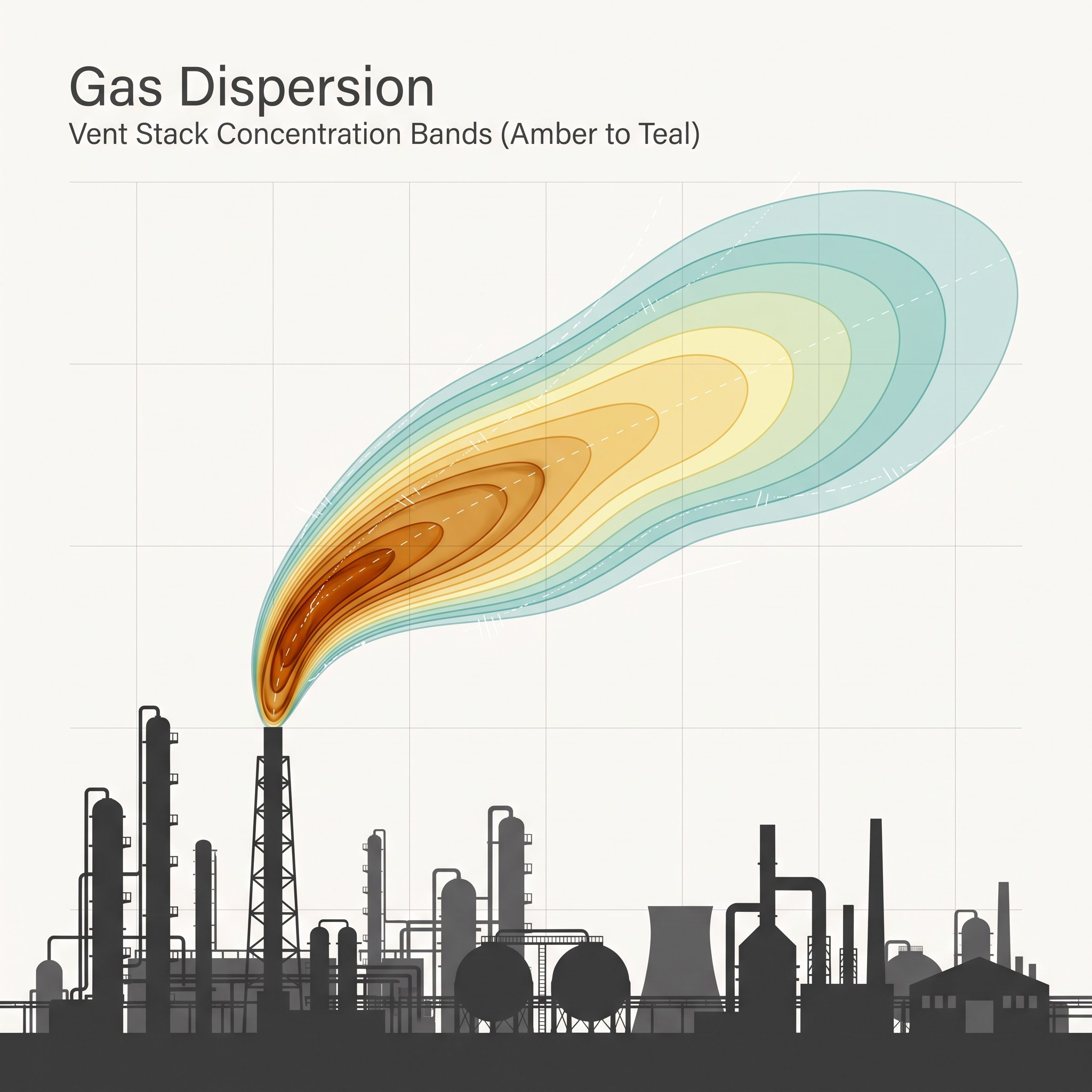
In hydrocarbon facilities, even a minor gas leak can quickly create a large flammable vapour cloud. Dispersion analysis predicts how toxic gases, smoke or flammable vapours spread after a release, so that hazard zones can be defined and effective safety measures put in place.
Hazard zones based on LEL
Consequence modelling with tools such as PHAST or ALOHA evaluates hazard zones using percentages of the Lower Explosive Limit (LEL), which define the real explosion footprint:
- 60% LEL region. The highest ignition probability and the most immediate explosion risk.
- 40% LEL zone. The cloud is still expanding and the danger remains elevated.
- 10% LEL boundary. The outer flammable region, where ignition is still possible if an ignition source is present.
Release rates are not linear
Simulation of LPG leaks during cylinder filling or transfer, under standard wind conditions, shows how strongly release rate drives the hazard. A minor propane leak produces a flammable cloud extending tens of metres at the 10% LEL threshold. When the leak rate quadruples, the hazardous distance nearly doubles. Similar behaviour is seen for butane and isobutane. Because hazard zones do not grow in proportion to the leak, small increases in release rate can enlarge the explosion footprint significantly, and propane poses the highest risk because of its lower boiling point and rapid vaporisation.
Key objectives of a dispersion analysis
- Hazard identification. Assess risks from fires, explosions and toxic exposure.
- Release estimation. Quantify the amount of hazardous material entering the atmosphere.
- Vent optimisation. Determine the ideal height and location of vents for safe dilution and ground-level safety.
- Emergency planning. Design safe evacuation routes and define exclusion zones based on how the cloud behaves.
Why it matters
- Personnel protection. It prevents toxic exposure by assessing cloud extent and toxicity.
- Structural integrity. It evaluates potential explosion overpressure to confirm blast resistance.
- Environmental impact. It monitors pollutants to support air-quality compliance.
- Thermal assessment. It maps flame geometry and radiation intensity to protect nearby infrastructure.
Accurate boundaries feed directly into electrical area classification (to specify explosion-proof equipment), emergency response planning (safe access routes for firefighters) and layout optimisation (firewater monitor placement and muster point selection).
Standards and tools
- Software. PHAST-RISK and DNV GL standards for consequence modelling.
- Regulatory codes. US EPA (vent height), OSHA and API 752 (building siting).
- Risk frameworks. TNO Purple Book (QRA), CPR 18E and NFPA 704.
What the analysis delivers
- Thermal radiation isotherms that map heat exposure.
- Flammable and toxic isopleths showing gas concentrations and LFL levels.
- Explosion modelling covering blast overpressure and BLEVE scenarios.
- Impact analysis of potential fragments and missile trajectories.
How EnTech can help
We provide smoke and toxic gas dispersion studies that deliver enhanced emergency preparedness, proven regulatory compliance and data-driven safety decisions. Contact us at info@EnTech-Solution.com.