
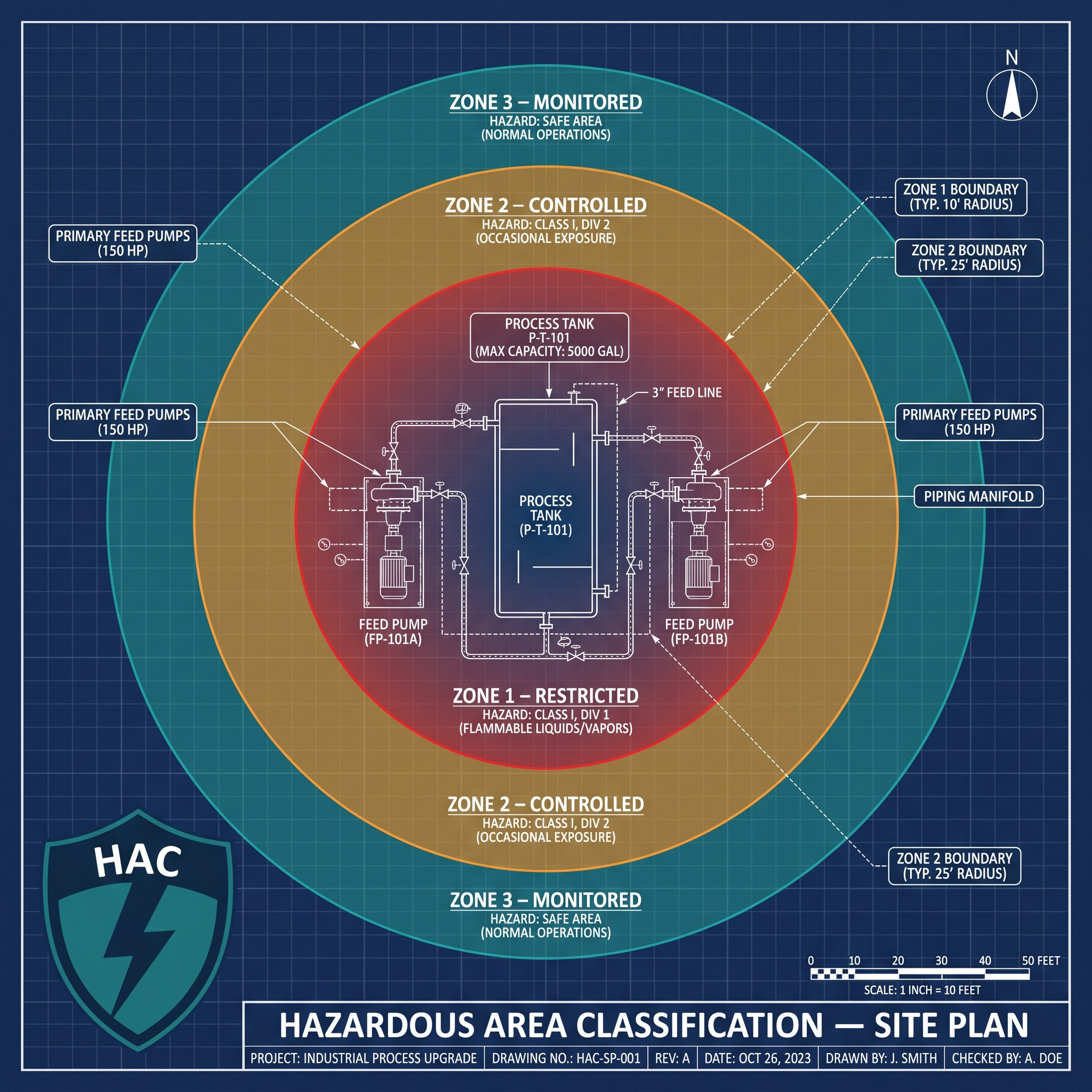
In oil and gas, petrochemical, chemical and power facilities, flammable gases, vapours and combustible dusts create a constant explosion risk. Managing safety in these atmospheres is a precise science. Hazardous Area Classification (HAC) is the frontline defence: it maps where ignitable concentrations can exist and makes sure equipment never becomes an active ignition source.
What is HAC?
HAC is a systematic risk assessment process that identifies and classifies areas where explosive atmospheres may occur. It defines hazardous zones according to the likelihood and duration of flammable gas, vapour or dust being present, which allows correct selection of equipment and protective measures.
Purpose of HAC
- Identify hazardous zones within process facilities.
- Classify areas by the probability and duration of explosive atmospheres.
- Support safe selection of electrical and mechanical equipment (Ex-rated).
- Reduce explosion risk to ALARP.
- Ensure compliance with regulations and standards.
Fire triangle versus explosion pentagon
Fuel and oxygen are inherent to operations, so safety engineering concentrates on eliminating ignition sources. For dust hazards, controlling dispersion and confinement is also critical to prevent blast waves.
Classification systems
IEC / ATEX zonal system (IEC 60079)
- Zone 0 / Zone 20. Continuous hazard, more than 1,000 hours per year.
- Zone 1 / Zone 21. Occasional hazard, 10 to 1,000 hours per year.
- Zone 2 / Zone 22. Abnormal hazard of short duration, less than 10 hours per year.
Zones 0, 1 and 2 apply to gas and vapour. Zones 20, 21 and 22 apply to dust.
NEC division system
- Division 1. High probability zone, combining Zone 0 and Zone 1.
- Division 2. Low probability zone for abnormal conditions, equivalent to Zone 2.
HAC methodology
The study uses structured, standards-based guidelines across defined plant areas to identify potential release sources and ignition risks. For each area it evaluates the type of hazardous substance (gas, vapour or dust), the release grade and ventilation effectiveness, the zone classification and extent, and equipment suitability. A multidisciplinary workshop is often used to reach realistic and practical results.
Ex protection and thermal controls
- Containment versus prevention. Flameproof (Ex d) enclosures contain an internal explosion, whereas Increased Safety (Ex e) and Intrinsic Safety (Ex i) prevent arcs, sparks and thermal energy altogether.
- Thermal safety (T-code). Equipment surface temperature must stay below the auto-ignition temperature (AIT) of the material, allowing for ambient changes and insulating dust layers.
HAC outputs
- Hazardous Area Classification drawings.
- Zone maps (Zone 0 / 1 / 2 for gas and vapour, Zone 20 / 21 / 22 for dust).
- Equipment suitability recommendations.
- A clear, auditable HAC report aligned with standards.
- Input to electrical safety, explosion protection and risk assessments.
Accurate HAC drawings, reports and equipment schedules connect complex standards to real-world plant integrity, prevent explosions, protect people and assets, and demonstrate compliance with IEC, NEC and other international standards.
How EnTech can help
We provide systematic identification of hazardous release sources, clear zone classification and extent definition, practical Ex equipment selection recommendations and auditable technical documentation. Contact us at info@EnTech-Solution.com.