
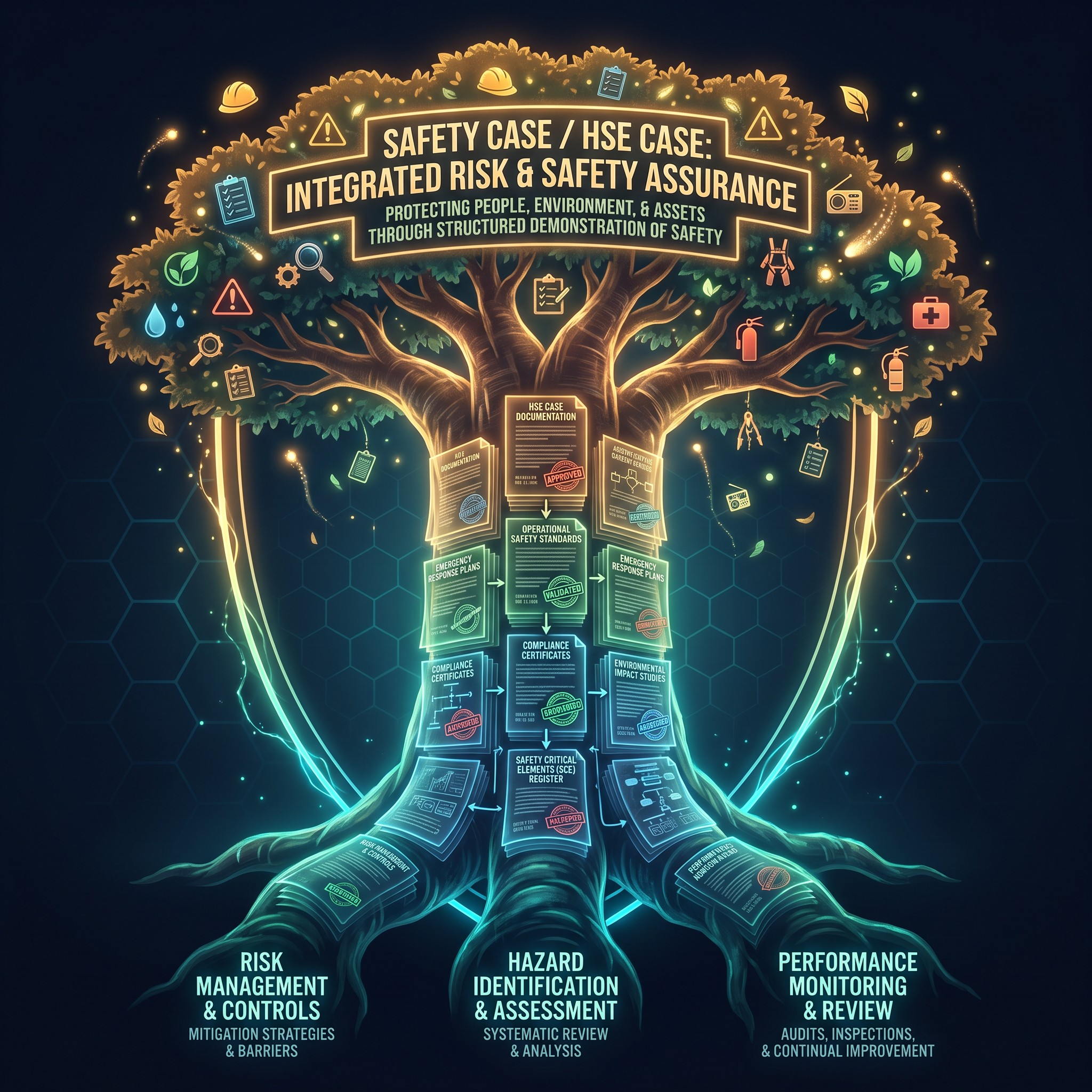
In high-hazard industries, a Safety or HSE Case is far more than a regulatory check-box. It is a live, comprehensive demonstration that a facility understands its hazards and has put adequate controls in place to reduce risk to ALARP. In oil and gas, refining, petrochemicals and chemical processing, an effective HSE Case is the operational blueprint for preventing major accidents and keeping operations safe and sustainable.
What is a Safety / HSE Case?
It is a living suite of documents that sets out a structured, evidence-based argument to convince operators, regulators and stakeholders that major accident hazards are being systematically managed throughout the facility’s lifecycle.
The three questions a Safety Case must answer
1. What can go wrong?
All Major Accident Hazards (MAHs) are identified through structured hazard identification and risk assessment studies such as HAZID, HAZOP and Bowtie Analysis.
2. What barriers are in place?
Engineering and procedural safeguards are defined, including active and passive fire protection, emergency shutdown systems, gas detection, operating procedures and emergency response arrangements.
3. Are these barriers reliable?
It is demonstrated that Safety Critical Elements (SCEs) are properly maintained, tested, audited and continuously monitored so that they keep performing across the facility lifecycle.
Core pillars of an effective Safety Case
- Clarity and communication. Concise, accessible language with flowcharts, tables and structured data, so that safety limits, operating conditions and maintenance requirements can be applied on site.
- Completeness and coverage. All reasonably foreseeable hazards across every operational phase are identified, including normal operation, start-up, shutdown and transient states, with no blind spots.
- Accuracy and living-document management. The case reflects the real as-built facility or current design intent. Periodic review and robust change management keep it aligned with plant modifications.
- Robust evidence and verification. Claims about SCEs and engineered safeguards are supported by fit-for-purpose modelling, risk studies and verifiable engineering data.
- Interface and lifetime integrity. Boundaries with external facilities and dependencies on external power and utilities are clearly defined, with forward plans to maintain safety through the asset’s design life.
Why it matters
A well-developed Safety / HSE Case bridges executive leadership, operational teams and regulatory authorities. It turns safety management from a reactive approach into a proactive, barrier-based framework focused on preventing major accidents before they occur. Beyond compliance, it protects people, safeguards assets, preserves business continuity and reinforces an organisation’s licence to operate.
How EnTech can help
- Major Accident Hazard (MAH) identification and consequence assessment.
- Safety Critical Element (SCE) identification and performance standard development.
- ALARP demonstrations and Formal Safety Assessments (FSA).
- Barrier management and Bowtie studies.
- Regulatory compliance reviews and Safety Case documentation.
Contact us at info@EnTech-Solution.com.