
Insights & Updates
Insights
Technical insights and updates from the EnTech team.

CFD Modelling for Flare Systems: Metering Accuracy, Combustion Efficiency and Flame Stability
When a flare stack stands more than 100 metres in the air, physical probing is impractical, drone tracking has limits, and regulatory compliance does not wait. Computational Fluid Dynamics (CFD) becomes a critical engineering tool in this situation. What CFD delivers for flare systems CFD uses high-performance 3D numerical simulation to replicate real operating conditions. […]

Flare Radiation and Dispersion Study: Keeping Emergency Flaring Safe and Compliant
A flare stack protects a plant by safely burning off excess gas during upsets and emergencies. Without precise modelling, however, the same flare can become a hazard to people and nearby assets. A comprehensive Flare Radiation and Dispersion Study is a fundamental tool for validating that flare systems are safe and compliant. What is a […]

CFD Explosion Study: Realistic Overpressure Modelling for Congested Facilities
In oil and gas, petrochemical, chemical and power facilities, explosion hazards are a critical threat to personnel safety, asset integrity and business continuity. A structured CFD Explosion Study provides a realistic and defensible way to assess explosion consequences by simulating gas dispersion and overpressure in complex, congested environments. What is a CFD explosion study? Computational […]

Gas Dispersion and Plume Modelling: Understanding Flammable and Toxic Hazard Zones
In hydrocarbon facilities, even a minor gas leak can quickly create a large flammable vapour cloud. Dispersion analysis predicts how toxic gases, smoke or flammable vapours spread after a release, so that hazard zones can be defined and effective safety measures put in place. Hazard zones based on LEL Consequence modelling with tools such as […]

Matrix of Permitted Operations (MOPO): Turning Operational Risk into Clear Decisions
In high-risk operations, safety depends on one thing: clear decisions. The Matrix of Permitted Operations (MOPO) must work as a real-time decision framework for site personnel, not as a passive procedure on a shelf. When a facility fails to link its safe operating limits to real operational threats, two problems appear: high-risk concurrent tasks are […]
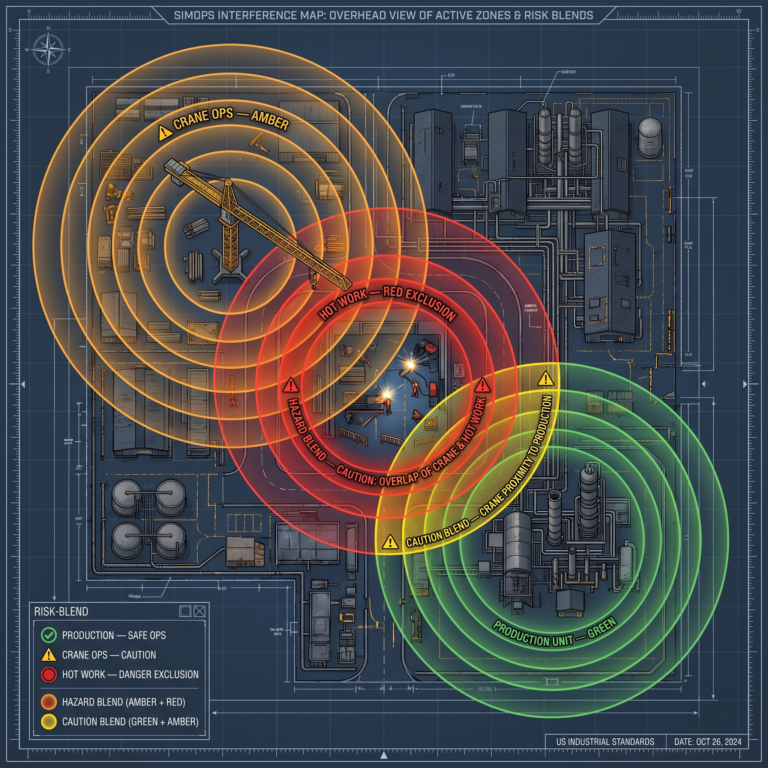
SIMOPS: Managing Risk in Simultaneous Operations
In oil and gas, petrochemical, chemical and power facilities, running several activities at the same time is often a necessity. Without proper control, it can also lead to conflicts, unsafe conditions and major incidents. A structured Simultaneous Operations (SIMOPS) framework keeps these overlapping activities safe without compromising operational integrity or personnel safety. What is SIMOPS? […]

HAZID, ENVID and OHID: Identifying Safety, Environmental and Health Risks in FEED
In high-risk industries, environmental impacts are not secondary concerns. They are critical risk drivers that affect regulatory compliance, project viability and corporate reputation. A critical milestone in the FEED phase is running integrated HAZID, ENVID and OHID studies. These multidisciplinary workshops identify safety, environmental and occupational health risks early, before they turn into costly issues, […]

HAZID, HAZOP and LOPA: How They Fit Together Across the Process Safety Lifecycle
Managing Major Accident Hazards (MAHs) in high-hazard industries cannot rely on a single assessment tool. Safe plant design and operation depend on combining HAZID, HAZOP and LOPA at the right stages. Confusing the methods can leave critical gaps in a facility’s defence barriers, and understanding how these Process Hazard Analysis (PHA) methods hand over to […]

HAZOP Study: A Complete Guide to Hazard and Operability Studies
In oil and gas, petrochemical, chemical and pharmaceutical operations, understanding how process deviations can lead to catastrophic failures is essential for operational integrity and personnel safety. One of the most globally recognised and proactive frameworks for this is the Hazard and Operability Study, or HAZOP. What is HAZOP? A HAZOP is a systematic, structured and […]

HAZID Study: Finding Hazards Early, Before They Become Expensive
In oil and gas, petrochemical, chemical and pharmaceutical projects, identifying hazards early is critical for safe and reliable execution. One of the most effective early-stage techniques is the Hazard Identification Study, known as HAZID. What is HAZID? HAZID is a workshop-based, qualitative risk analysis technique used to identify potential hazards and threats associated with a […]