
Insights & Updates
Insights
Technical insights and updates from the EnTech team.

Emergency Response Planning (ERP): From Panic to Coordinated Action
In process safety and major hazard operations, preventing accidents is always the first goal. But when an unforeseen Major Accidental Event (MAE) does occur, survival depends on how quickly and in how structured a way the site responds. An Emergency Response Plan (ERP) is not just a regulatory requirement. It is an operational framework that […]

Emergency Systems Survivability Assessment (ESSA): Will Your Defences Survive a Major Accident?
In high-hazard process facilities, simply installing Safety Critical Elements (SCEs) is not enough. The real engineering question is whether your active defences will survive and stay fully operational during a real major accident. An Emergency Systems Survivability Assessment (ESSA), guided by standards such as ADNOC ST-08, API 14J / 14C and API 2018, evaluates whether […]

Escape, Evacuation and Rescue Analysis (EERA): Protecting People When Things Go Wrong
In process industries, ensuring personnel life safety during an emergency is a fundamental requirement for safe project execution. In high-hazard facilities, people must be able to navigate, muster and evacuate safely during a Major Accident Hazard (MAH) event. Escape, Evacuation and Rescue Analysis (EERA) provides a structured, engineering-based framework, within COMAH and Safety Case regimes, […]

Equipment Layout and Unit Plot Plan: Siting for Safe Distance and Safe Operation
In high-risk industries such as oil and gas and chemical processing, plant layout is a fundamental risk-control tool. A critical document for this is the Equipment Layout (Unit Plot Plan), developed in line with safe distance and equipment siting principles. What is an equipment layout? It is a detailed plan that defines the exact location […]

Fire and Gas (F&G) Mapping: Why 3D Detector Coverage Beats 2D
In high-risk industrial facilities, effective Fire and Gas (F&G) detection is not only about installing detectors. It is about ensuring complete and reliable coverage where hazards can actually occur. Designing an effective Fire and Gas System (FGS) needs accurate detector coverage calculations, and that is where F&G mapping plays a critical role. What is F&G […]
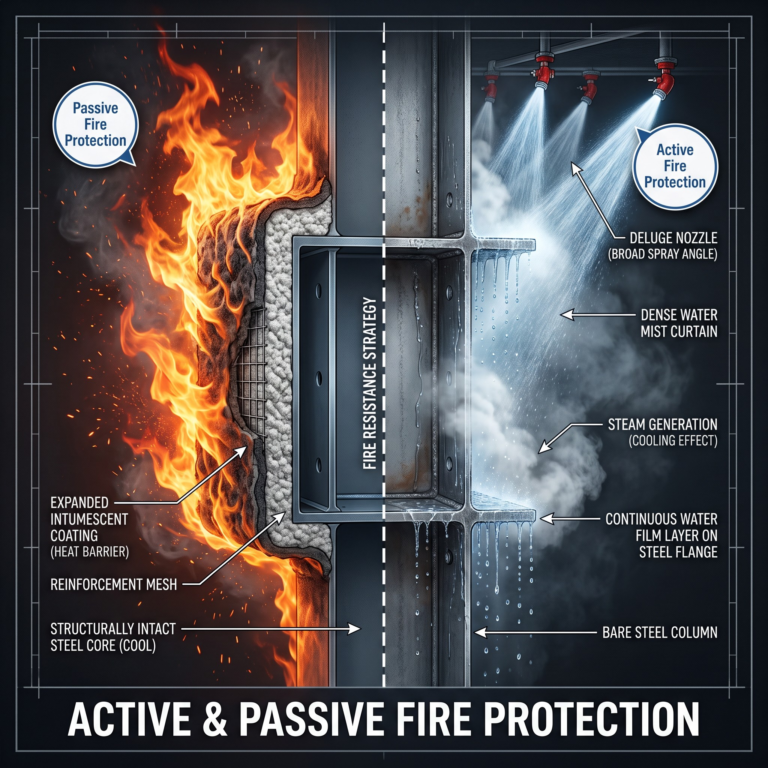
Active and Passive Fire Protection: A Unified Fire Safety Strategy
Fire is not just an emergency scenario in high-risk industries. It can escalate rapidly, endanger lives, damage assets and cause long shutdowns. Effective fire safety relies on integrating Active Fire Protection (AFP) and Passive Fire Protection (PFP), so that fires are suppressed and structures survive long enough for people to respond. 1. Active Fire Protection: […]
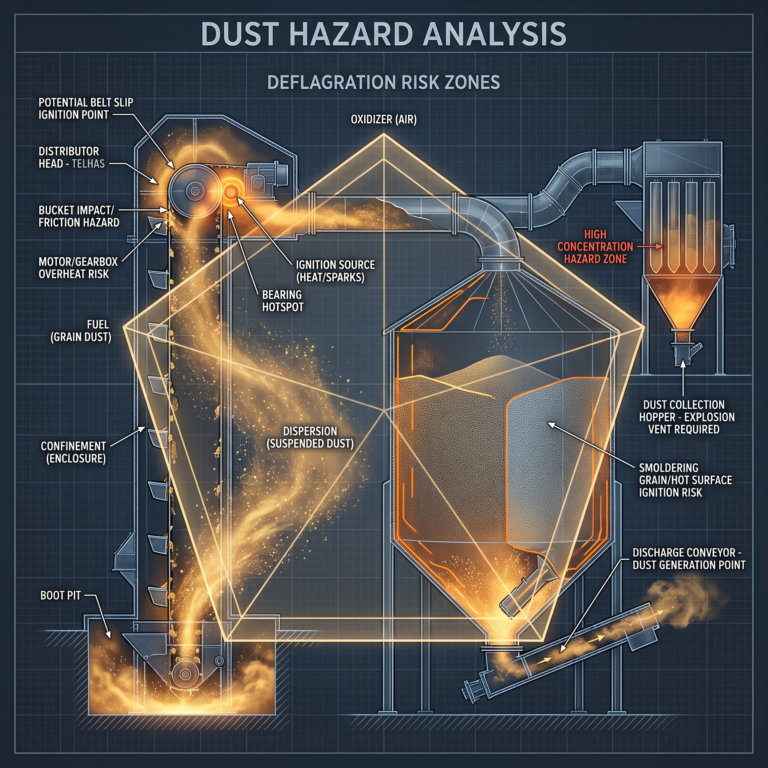
Dust Hazard Analysis (DHA): Preventing Combustible Dust Explosions
In bulk solid and powder processing industries, and across oil and gas, petrochemical, chemical, power and manufacturing, combustible dust is not just a by-product. It is a critical explosion risk that can escalate rapidly, endanger lives, damage assets and cause major shutdowns. While liquid fires are widely understood, particulate flash fires and secondary dust explosions […]
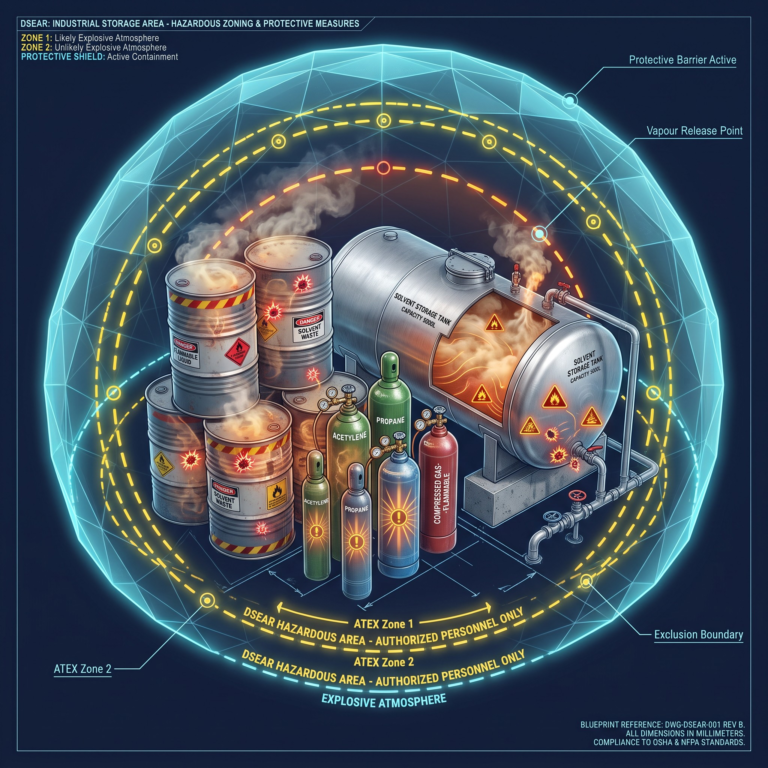
DSEAR: Managing Dangerous Substances and Explosive Atmospheres
Ignoring explosive and corrosive risks can expose a facility to serious operational and legal consequences. In environments handling flammable gases, volatile liquids or combustible dusts, safety depends on strict compliance, and this is where the Dangerous Substances and Explosive Atmospheres Regulations (DSEAR) become essential. What is DSEAR? DSEAR (the Dangerous Substances and Explosive Atmospheres Regulations […]

Hazardous Area Classification (HAC): Controlling Ignition Sources in Explosive Atmospheres
In oil and gas, petrochemical, chemical and power facilities, flammable gases, vapours and combustible dusts create a constant explosion risk. Managing safety in these atmospheres is a precise science. Hazardous Area Classification (HAC) is the frontline defence: it maps where ignitable concentrations can exist and makes sure equipment never becomes an active ignition source. What […]

Modelling Corrosion and Corrosion Protection: Predicting Degradation Before It Becomes Failure
Corrosion is a complex electrochemical phenomenon that can significantly affect the safety, integrity and lifecycle cost of industrial assets. Traditional design often relies on conservative assumptions that may not represent real operating conditions. In process industries and energy infrastructure, managing material loss from corrosion is critical to long-term asset integrity. The power of multiphysics simulation […]